
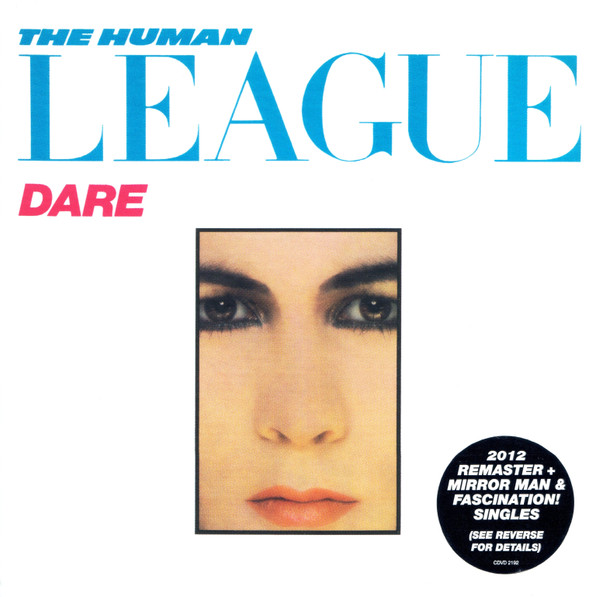
From The Archives. Released April 4th 2012.
The problem with the Human League’s Don’t You Want Me is that it was shorn long ago of all its context. As an example, sitting within the confines of Dare, it’s possible to see how much the escapism of its pastiche-friendly video contrasts sharply with the role reversed female empowerment of the lyrics. You can argue that many of the era’s other co-opted party records have done little to deserve being blared out whilst people shop or eat either, but whatever the backdrop, Don’t You Want Me manages to remain simultaneously dignified, timeless and populist.
The back story is fairly well known; without a band after the departures of founders Martyn Ware and Craig Marsh, bob-wielding singer Phil Oakey met teenage ingénues Joanne Catherall and Susanne Sulley in a nightclub and, along with fellow newcomers Ian Burden and Jo Callis, went to work with former Buzzcocks producer turned synth pop auteur Martin Rushent. Having spent in their various guises the previous three or four years failing to locate much enthusiasm amongst the record buying public, the smart money was on a messy, self-indulgent implosion; what came instead was a sea change in British pop.
Oakey’s main problem was that Ware and Marsh were the League’s instrumentalists; having just invested in a ton of state-of-the-art equipment, Rushent stepped into the breach as the technical maestro, performing a similar role to that of Trevor Horn on ABC’s The Lexicon of Love. What both virtuoso turns proved was that even with performers at times being reduced to the role of bystander, where the base material was stuffed full of quality, all the microprocessors in the world could only add a sense of gloss. Undeniably, Dare’s enduring appeal lies almost entirely in the material’s expertly crafted pop.
Britain in 1981 was about as grimmer place to live as almost anywhere else in Europe, East or West, and Yorkshire, with its manufacturing, coal mining and steel mills already in commercial retreat, was treated to some of the harshest lessons in Thatchernomics. What the people needed was escapism, to dress up and lose themselves in Saturday nights, and a soundtrack to go with it. Oakey and Burden captured this desire perfectly on Sound of The Crowd, an oddity that had the hallmarks of Bowie on a budget, a call to arms that could also be sung with gusto on Sundays, Mondays, Tuesdays and all the 24-hour periods of boredom and bleakness that formed the countdown to the next weekend.
The man who had once sung ‘Listen to the voice of Budda/Saying stop your sericulture’ was now attempting to communicate more directly with what was suddenly a very receptive audience. Love Action, with its disco ready vibe, inescapably funky bass and cat-like backing vocals from Sulley and Catherall was their glorious Chic moment, while Open Your Heart saw them take on the might of ABBA and come out with a creditable draw.
Both singles took the band into the upper reaches of the charts, but Dare was more than just a small clutch of highly memorable apexes. Opener Things That Dreams Are Made Of spelled out the next generation’s emerging ambivalence to socialism with a small s, cataloguing sins both of the flesh and of disposable incomes, Seconds attempted to get inside the mind of Lee Harvey Oswald, whilst I Am the Law found a self-righteous Judge Dredd character seeing himself dispensing justice as a means of protecting us from ourselves.
The nineteen eigthies was of course the most successful period of the twelve-inch single, and in celebration of that a number of reimagined versions fill up the first additional disc, most it has to be said failing to add much to the story. Mysteriously encouraged however, the compilers have then added a second, mostly salvaged from the stop gap 1983 EP Fascination!, which contained then as now the patchy single of the title, to which is added Mirror Man and a batch of fan only deep cuts. All we can be thankful for is that from the temptation to throw in the turgid twilight career moments Human, Louise or the mundane Life On Your Own is resisted.
In the end the contrast between the authenticity of that versus Dare, Don’t You Want Me And all, reveals itself. Like all watersheds, its hedonistic simplicity still appeals, even if the noise itself is dated. If you needed a reminder of its existence, then this new release should be it. But there’s no need to distract yourself with all the marketing department’s dead ends. Simply buy it, settle back into the ten original tracks and listen in sequence just as intended, and celebrate the unlikeliest of synth pop masterworks.


